All products › Vehicles
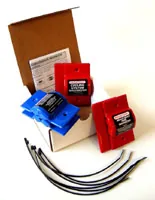
Magnetizer® · Item #5000D · Vehicles
Magnetizer Diesel Performance Maximizer
The diesel version of the Performance Maximizer, for the fuel line of diesel cars, pickups, vans and light trucks.
Cable ties included. Opens the product page on emediapress.com, where you buy it. Ships direct from the manufacturer.
Results shown are manufacturer test data or results reported by Magnetizer Inc.; figures link to their source where we hold one. Results vary.
What it does
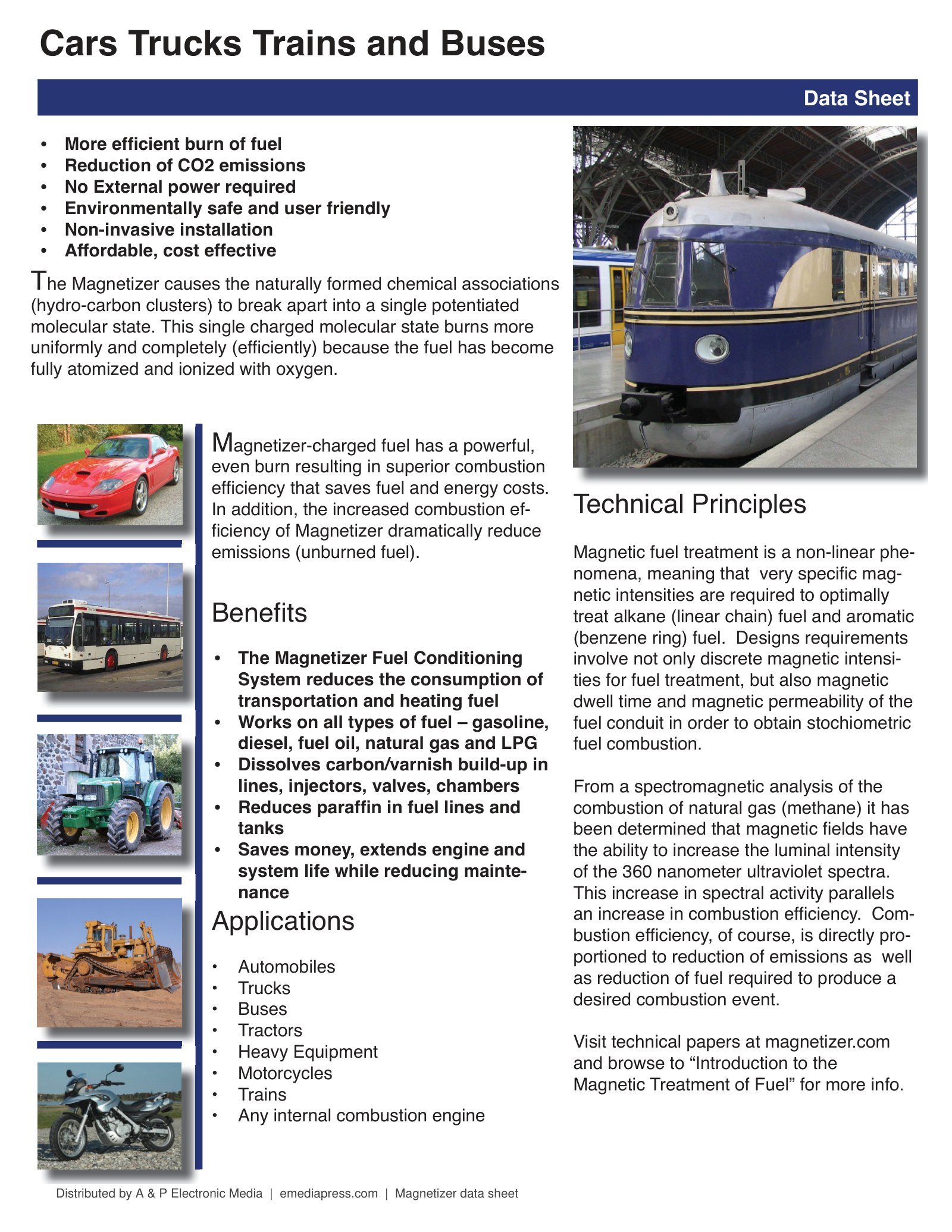
- Works on diesel: more efficient burn of fuel, reduction of CO2 emissions (data sheet)
- Reduces paraffin in fuel lines and tanks; dissolves carbon build-up (data sheet)
- Clamps on the outside of the fuel line — no cutting, no tools, no power (data sheet)
The manufacturer’s data sheet
Open full size · Download PDF
Documents for this product
- Cars, Trucks, Trains & Buses data sheet (PDF, 1 page) · image
- Magnetizer Fuel Test Data (PDF, 23 pages) — diesel tests: Brazil bus p. 20, Sri Lanka p. 17, China Railway p. 19, Mercedes-Benz p. 9, Air Force MEEP p. 6
Proof for diesel engines
Diesel results in the manufacturer’s report: 20.11% more km per litre on a Scania passenger bus over 6,700 km, CREA-PA Brazil, May–June 2003 (report p. 20); 60.7% and 61.2% less smoke opacity on two diesel pickups, Sri Lanka EPA, 17 May 1999 (report pp. 17–18); 4.88–5.91% average fuel saving on a diesel locomotive, China Academy of Railway Science, 1996–97 (report p. 19); CO 0.09 to 0.04 at 600 rpm on a diesel bus, Mercedes-Benz Argentina, 10 Nov 1993 (report p. 9); the US Air Force MEEP evaluation ran one diesel bus for six months and recommended the system for Air Force use (report p. 6). The first two are tiles on the proof page. Manufacturer test data; results vary.
Installation
Cable ties are included. Strap the unit around the outside of the line with them — nothing is cut and nothing plugs in. Allow a stabilization period while old carbon clears: the manufacturer quotes 200–500 miles (report p. 23) and recommends an oil change after the first few hundred miles because loosened deposits end up in the oil (report p. 19).